How To Manage Water
A guide from Old Souls microFarm for residential farm-gardeners
In my first fall at Old Souls, in 2020, it hadn't rained in more than six weeks. I spent September and October dragging a hose from tree to tree, letting it drip for 45 minutes at each one so the roots would go into winter with a deep drink. Then, in mid-October, about three inches of rain fell in a day and a night. The ground was so dry and hard that most of it ran straight off.
That's the water problem on a small lot in Maine, and probably on yours: too much water, all at once, in the wrong place, and then not enough water, sometimes for weeks. For a while I thought of them as two different problems needing two different fixes. That isn't the best way to look at it, however. The same slope that sheds a storm in an hour is the slope that goes dry in August. The answer to both is to slow the water down, spread it out, and soak it into the ground, where it can wait until it's needed.
Ultimately, we are all facing weather events that are influenced by climate change, and so water management is a necessary approach to helping your land become more resilient and capable of adaptation to setbacks and crises like drought or very heavy storms. While we are focused here on practical guidance for a particular set of issues having to do with managing water on a small property, I encourage you to keep in mind the larger context of our vulnerability to climate change.
At Old Souls that took two kinds of work: bioswales to catch the runoff, and storage and watering habits to carry the garden through a dry spell. Here is how to do both.
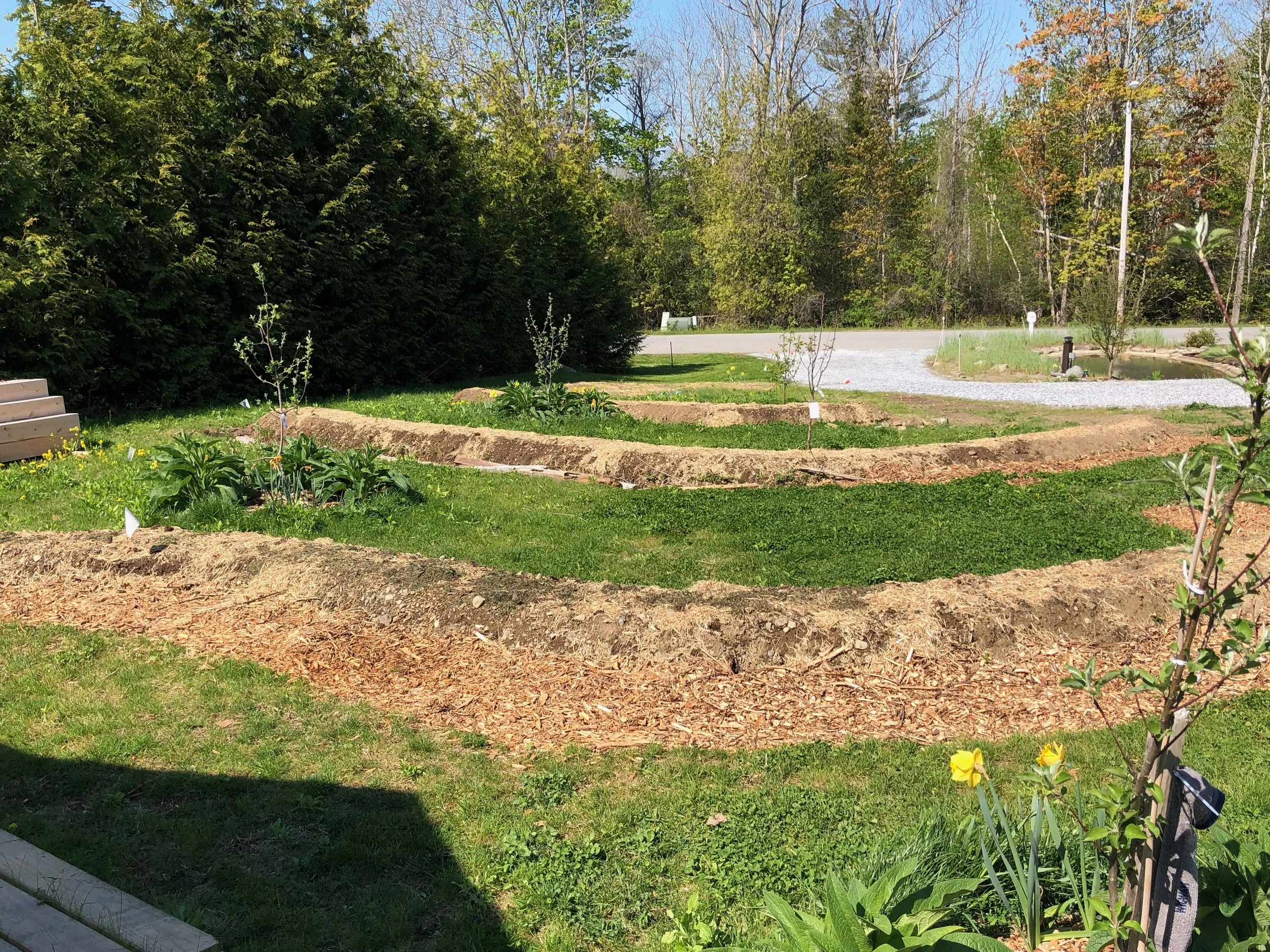
The South Orchard swales on May 17, 2021, freshly dug and topped with wood chips.
How To Create Bioswales
A swale is a level ditch dug across a slope, along its contour, with the upcast soil piled just below it as a low ridge called a berm, which then forms a crop planting row parallel to the swale. The swale is then filled with organic matter, like rotting wood and wood chips, up to ground level, a practice called hugelkultur. Water running downhill drops into the ditch, stops, and soaks slowly into the ground beneath the ditch and the berm. A bioswale is the same idea with the life of the soil in mind: the ditch isn't just catching water, it's growing fungi, bacteria, and roots.
A bioswale works on any lot with a noticeable slope and water that runs across it in a hard rain. On flat ground, water pools instead of running, and a rain garden (a shallow, planted basin) is the better tool.
Watch the water first. Walk the slope during a hard rain and note where it runs and gathers. Put swales across those paths, upslope of what you want to water.
Find the contour. Mark a level line across the slope with an A-frame level, a builder's line level, or a laser level. Stake it every few feet. A swale that isn't level becomes a ditch that speeds water away.
Call before you dig. Have underground utilities marked (in the U.S., call 811), and keep swales well away from foundations, septic systems, and wells, so you don't send water where it does harm.
Dig the ditch and build the berm. Pile the soil on the downhill side. Mine are three feet deep and three feet wide, dug by hand. A foot or two deep is plenty for most yards.
Fill with wood, if you have it. Logs, branches, and brush in the bottom, then wood chips on top. Use wood that rots readily, and skip black walnut and fresh cedar. The wood holds water and feeds the soil for years.
Plan the overflow. Decide where water goes when the swale is full: the next swale down, a pond, a rain garden, or a stone-lined spillway. Never let it spill onto a neighbor's land or a building.
Plant the berm right away. Sow a cover crop such as buckwheat or oats and peas to hold the soil the first season, then plant. Fruit trees and sprawling crops like squash do especially well just below a swale.
Maintain it. Top up the wood chips every year or two, keep the edges defined, and keep the ditch from filling with sediment.
The results at Old Souls showed up within weeks. During the first heavy rains after the swales went in, no runoff ran down the south side of the driveway, and the erosion there stopped. The berms turned out to be some of the best ground on Old Souls. Seven fruit trees grow just below the South Orchard swales, and in most years I haven't had to water them at all.
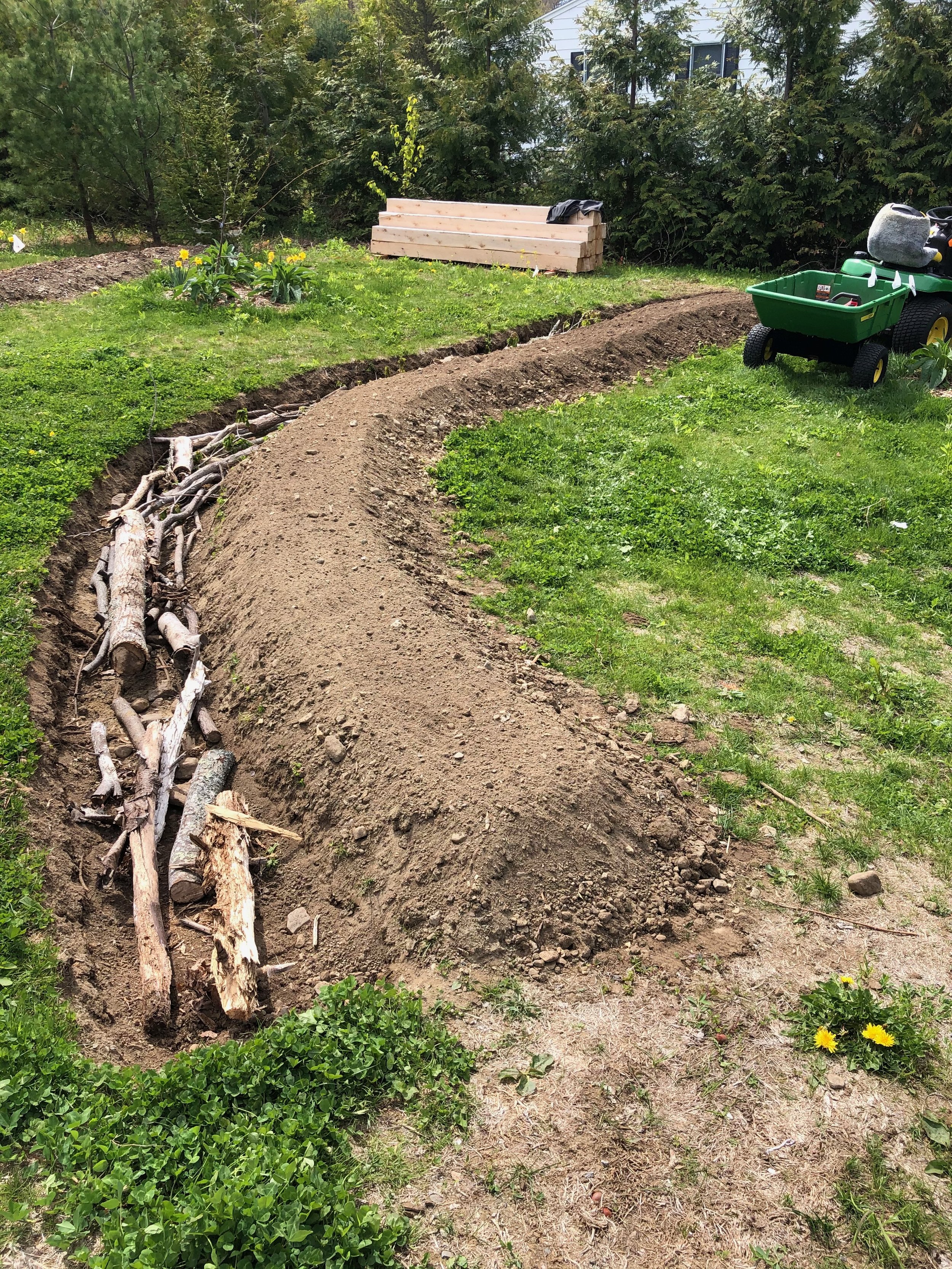
Logs and branches go into the bottom of the swale before the wood chips: hugelkultur, May 2021.
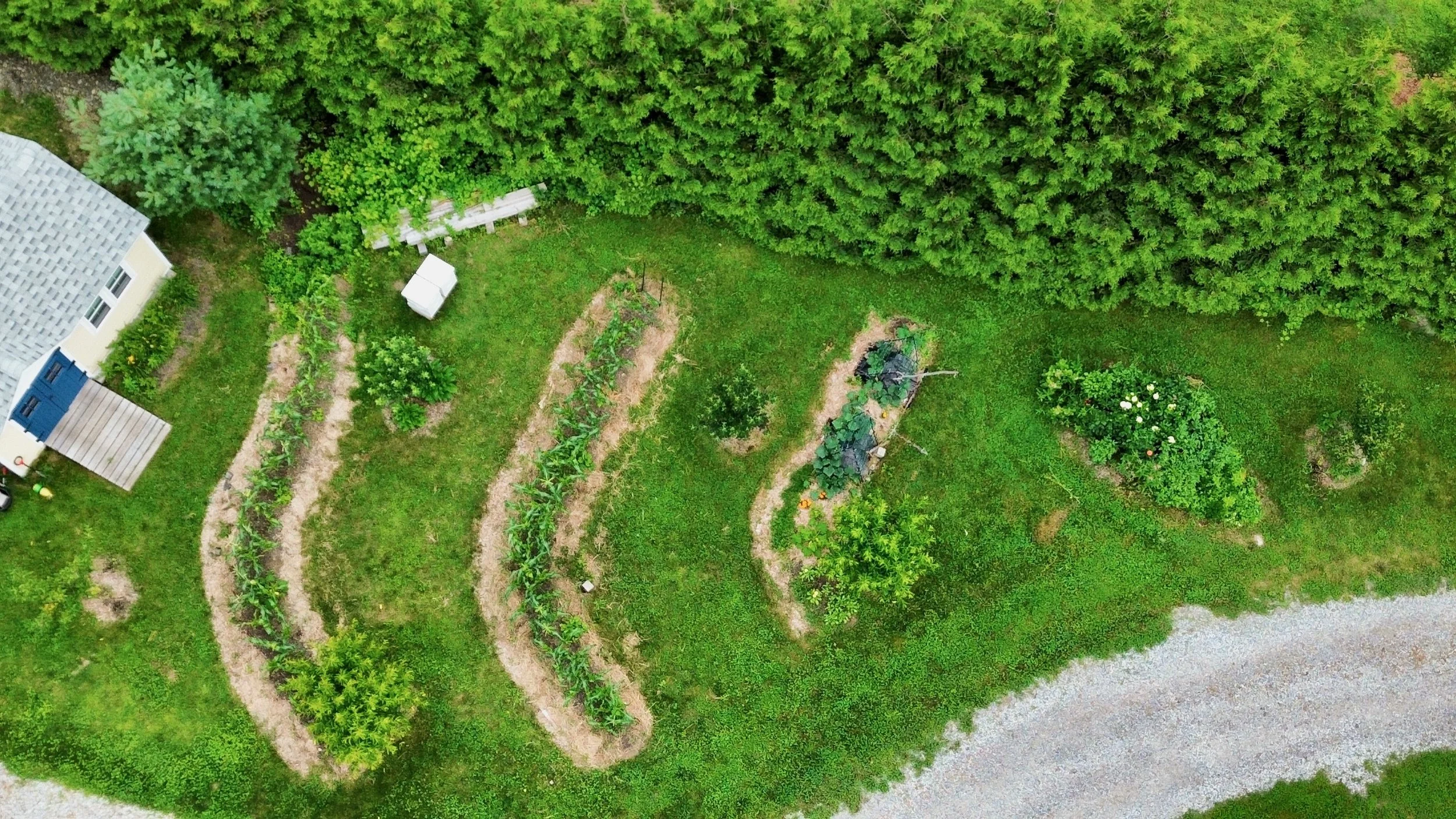
The South Orchard swales from above, 2023: each curving berm follows the contour of the slope. Aerial photo by Sarah Demer.
How To Manage and Store Water
How much, and when.
Aim for about an inch of water a week for vegetables, rain included. UMaine Extension suggests an inch and a quarter to an inch and a half in midsummer. A simple rain gauge tells you what the sky has already delivered.
Check before you water. Each morning, unless at least a quarter inch of rain has fallen in the past 24 hours, pull back the mulch and push a finger or a trowel four to six inches into the soil. If it's dry at that depth, water.
Water deeply and less often. Soak the soil five or six inches down, then let the top dry out. Early morning is best. Water the soil at the base of the plants, not the leaves.
Mulch everything you can. Wood chips, shredded leaves, or straw cut evaporation and keep roots cool.
My five-second rule. When I water, especially the vegetables, I use a hand-held sprinkling wand and pay close attention to how fast or slowly the water I apply around the base of each plant disappears into the soil. Apply water for five seconds, then watch for another five. If the water isn't absorbed quickly, I stop and go on to the next plant. This is time-consuming; in a dry summer it adds up to about 45 minutes a day. But my plants have been far less prone to over- or under-watering, and that outcome has been well worth the extra time and daily attention. At the same time as I'm watering I can observe the plants for signs of any disease, removing leaves and sometimes insects.
Deep watering before the freeze. In a dry fall, give trees and shrubs, especially anything planted in the last few years, a long, slow soak before the ground freezes. I run a hose at a slow drip for 45 minutes to an hour at the base of each, rotating through them over a week or two. Young trees going into winter dry are more likely to be damaged by cold.
Catching and storing water.
Put a rain barrel under any downspout near a garden bed. Use a lid or screen to keep out mosquitoes and leaves.
A full pond or swale is a reservoir. A small submersible pump can move surplus water into a storage barrel while it's there.
Rainwater from a roof is fine for ornamentals and, by most guidance, for watering the soil around food crops. Avoid splashing it on leafy greens you'll eat raw.
In a drought.
Water what matters most first: new plantings, young trees, and vegetables you're counting on.
Raise the mower or stop mowing. Let lawns go dormant; they recover.
Don't fertilize stressed plants; it pushes growth the plant can't support.
Before winter. Drain rain barrels and hoses, shut off and drain outdoor spigots, and disconnect anything that holds water and can freeze and split.
On a smaller lot: one short swale above a vegetable bed or a few shrubs, even six feet long, will catch roof or lawn runoff that would otherwise run away. A downspout aimed into a small swale or rain garden does the same work. One rain barrel, a watering wand, and a thick layer of mulch will carry a few beds through most dry spells.
To Dig Deeper
Brad Lancaster, Rainwater Harvesting for Drylands and Beyond, Volume 2: Water-Harvesting Earthworks (2nd ed., Rainsource Press, 2019). The best practical guide to swales, berms, and basins. Despite the title, it applies to wet climates too.
Toby Hemenway, Gaia's Garden: A Guide to Home-Scale Permaculture (2nd ed., Chelsea Green, 2009). The chapter on water explains swales and keeping water on the land at home-garden scale.
U.S. Environmental Protection Agency, Soak Up the Rain: Rain Gardens. For flat or small lots where a rain garden fits better than a swale.
UMaine Cooperative Extension, How often should I water my vegetable garden? Short and Maine-specific.
This guide is adapted from a book in progress about the residential farm-garden. To hear when it's ready, sign up for news.
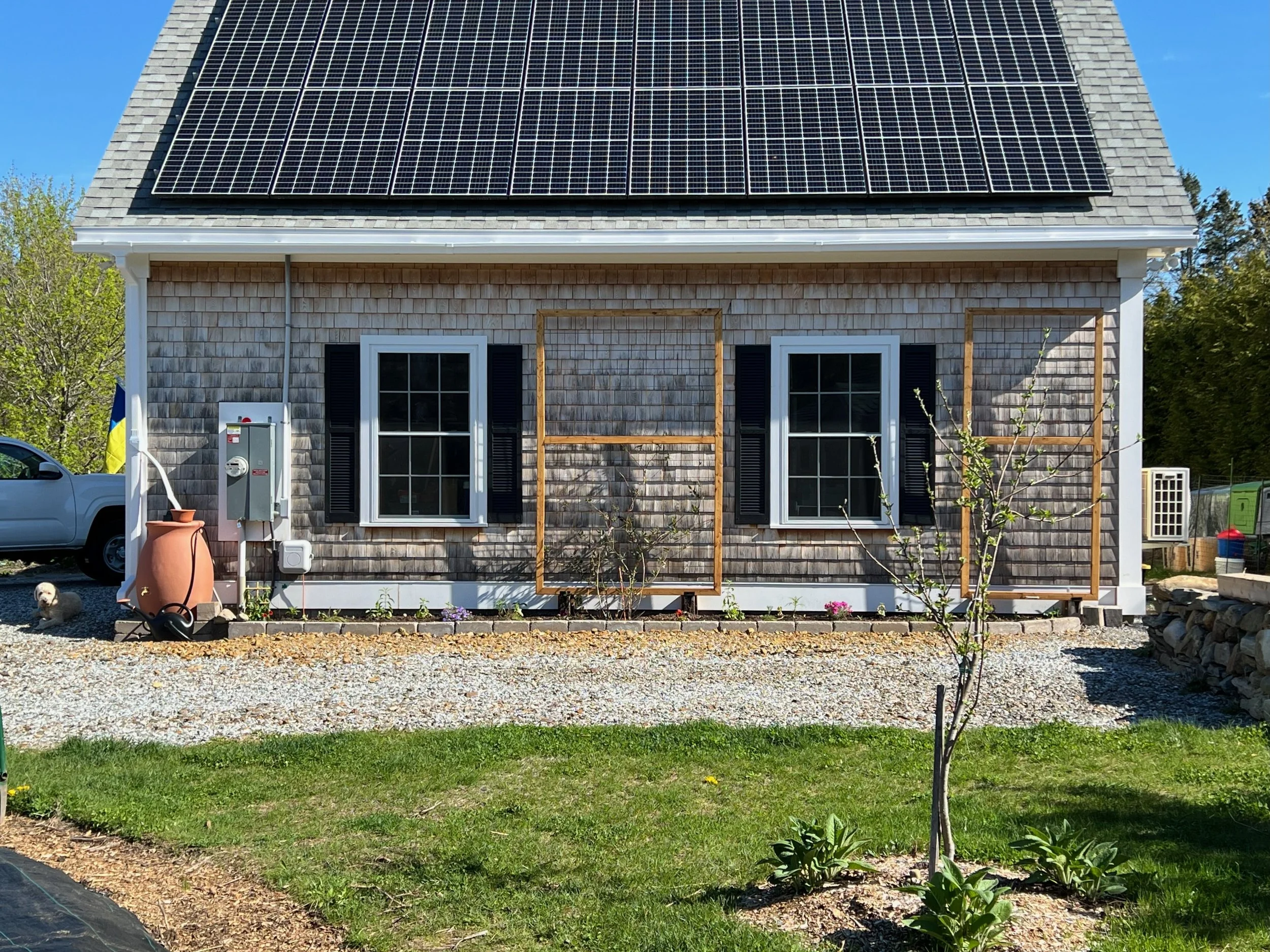
A rain barrel catches the garage roof for the planting bed beside it, 2023.