How To Build Your Soil
A guide from Old Souls microFarm for residential farm-gardeners
In September 2020 I wrote a journal entry called "Soil versus Dirt at 12 Linden Lane." Clearly, what I had at the time was dirt: gravel with a little sand and loam, and a lot of rocks, its topsoil long since scraped away. My soil test put a number on it: 2.5 percent organic matter, where a healthy garden soil runs 5 to 8 percent. Just by way of comparison, a healthy lawn usually tests around 5 percent organic matter, twice what I began with.
Organic matter is what turns dirt into soil. It holds moisture in the ground that might otherwise drain dry in a day. It feeds the bacteria, fungi, and worms that make nutrients available to plants. And it builds slowly, a little each year, from what you add: cut grass, compost, manure, leaves, the roots and stems of plants. The Maine Soil Testing Service's advice in 2020 was short and sweet: add manure, compost, or leaves every year.
Be patient with it. For the first two years I added compost from my compost pile faithfully, and the soil itself didn't seem to change much. What changed first was the plants: better yields, healthier growth. By the third year I could feel the difference in my hands when I dug the first few inches. In the fall of 2026 a new soil test came back: organic matter had gone from 2.5 percent to 6.3 percent, right in the middle of the healthy range.
If your lot still has its topsoil and healthy grass you're ahead of where I started. Most of the methods I used will be the same, but you may improve your soil more quickly. Two habits did most of the work at Old Souls: making compost, and preparing each bed with care. Here is how to do both.
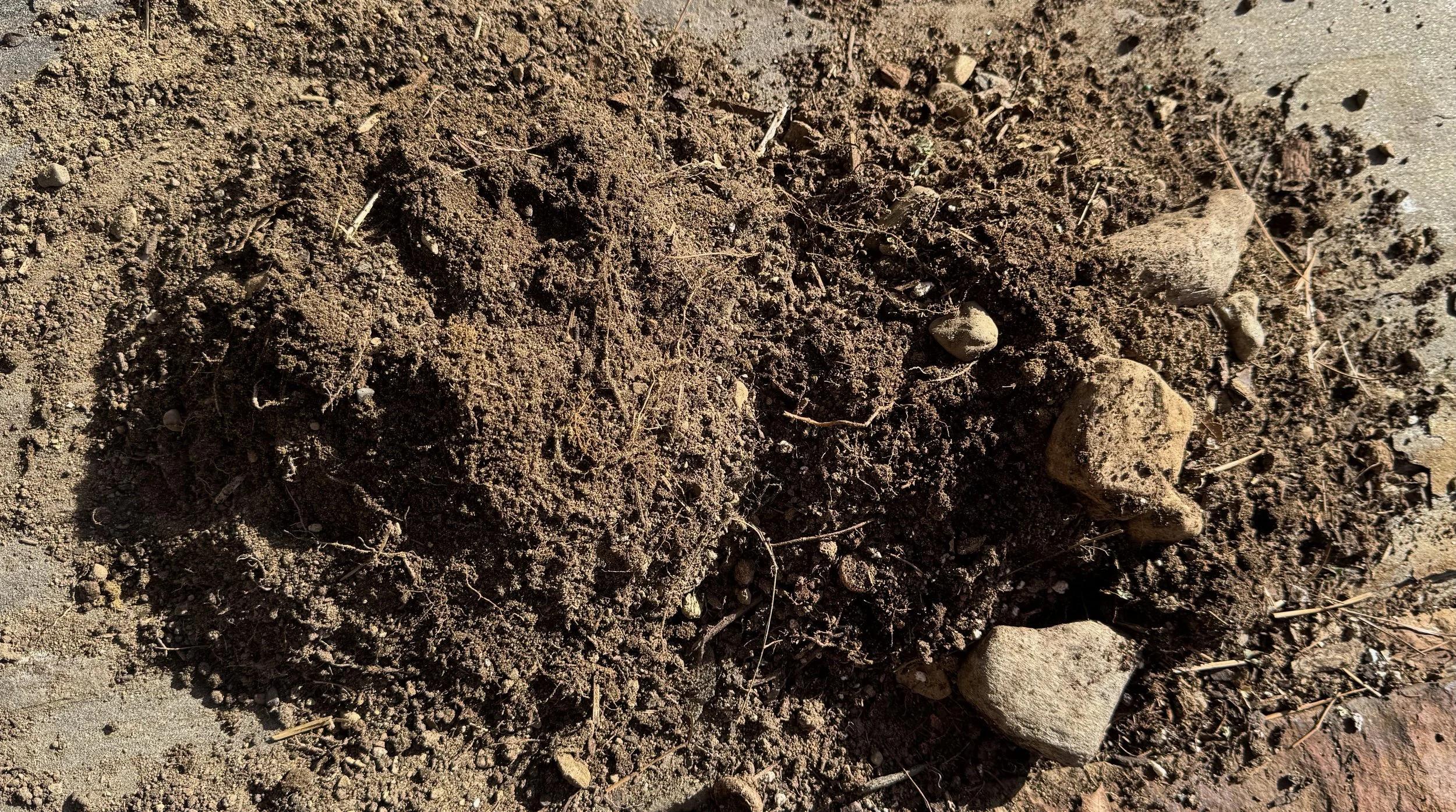
Two shovelfuls of Old Souls ground, 2026. On the right, the original soil, unamended and full of stones; on the left, soil from the top South Orchard berm after six years of compost, cover crops, and roots.
How To Make Compost
Compost is made by bacteria, fungi, worms, and insects breaking down plant material, and your job is to keep them fed, damp, and breathing. Feed them a mix of "greens" (kitchen scraps, fresh plant trimmings, grass clippings, manure), which supply nitrogen, and "browns" (dry leaves, straw, cardboard, wood chips), which supply carbon. Give them water and air, and they do the rest.
Choose a spot and a container. Somewhere level, partly shaded, and easy to reach from the kitchen and the garden. A bin or pile at least three to four feet on each side holds enough heat to work well. I'd use a bin rather than a tumbler.
Mix about two parts browns to one part greens, by volume. My recipe: kitchen scraps buried in roughly twice their volume of leaves, plus some straw and shredded paper or cardboard, a couple of shovelfuls of last year's compost and some manured soil to bring in the microbes, then a six-to-eight-inch blanket of leaves on top. Now that I have chicken manure I mix one part chicken manure with four to five parts by volume of shredded paper and cardboard, and mix thoroughly right away.
Chop it small. Smaller pieces break down faster. Shred leaves and cardboard; I chop the whole pile every so often with a small tiller.
Keep it as damp as a wrung-out sponge. A soaker hose is one way of maintaining the moisture in your compost piles. I tend to use a sprinkler on a timer at the same time as I water nearby planting beds.
Turn it at least every two weeks or so, and more often if possible. Turning lets air in. Good compost is made aerobically, with oxygen, and smells sweet and earthy. A sour or rotten smell means too little air or too many greens: turn it and add browns. If I can remember, I turn the pile at least twice a week thoroughly.
Sift and use it. When it's dark and crumbly, in my practice usually a couple of months, but longer depending on the season, sift out the big pieces (corn cobs, mostly) and put them back in the pile. I made my sifter from scrap one-by-one lumber and wire mesh, sized to sit on a bucket.
Three more sources of organic matter:
Comfrey. I grow comfrey under the fruit trees, cut its big leaves, and drop them at the trees' drip lines to rot in place, a permaculture practice called chop-and-drop. Leaves go into the compost too.
Leaf mold. Each fall I run leaves through a chipper-shredder and pile them in a wire bin. In a year or two they become leaf mold, a fine, moisture-holding mulch and soil builder.
Manure. Composted chicken, cow, or horse manure speeds everything up. Use it composted, not fresh, on food crops.
A caution: jumping worms. In June 2021 I found jumping worms in my compost, and they were still there in 2026. They're an invasive Asian earthworm that thrashes wildly when disturbed or handled and has a smooth, flush collar instead of a raised one. They chew leaf litter and soil into loose, coffee-ground-like granules that hold water and nutrients poorly, and they spread easily in compost, mulch, soil, and potted plants. There is no approved treatment. What helps: check your compost and any plants you bring in or give away; buy soil, compost, and mulch from suppliers who heat-treat them; and know that compost held above about 105°F for several days kills the worms and their cocoons. In Maine, report sightings to the Department of Agriculture, Conservation and Forestry.
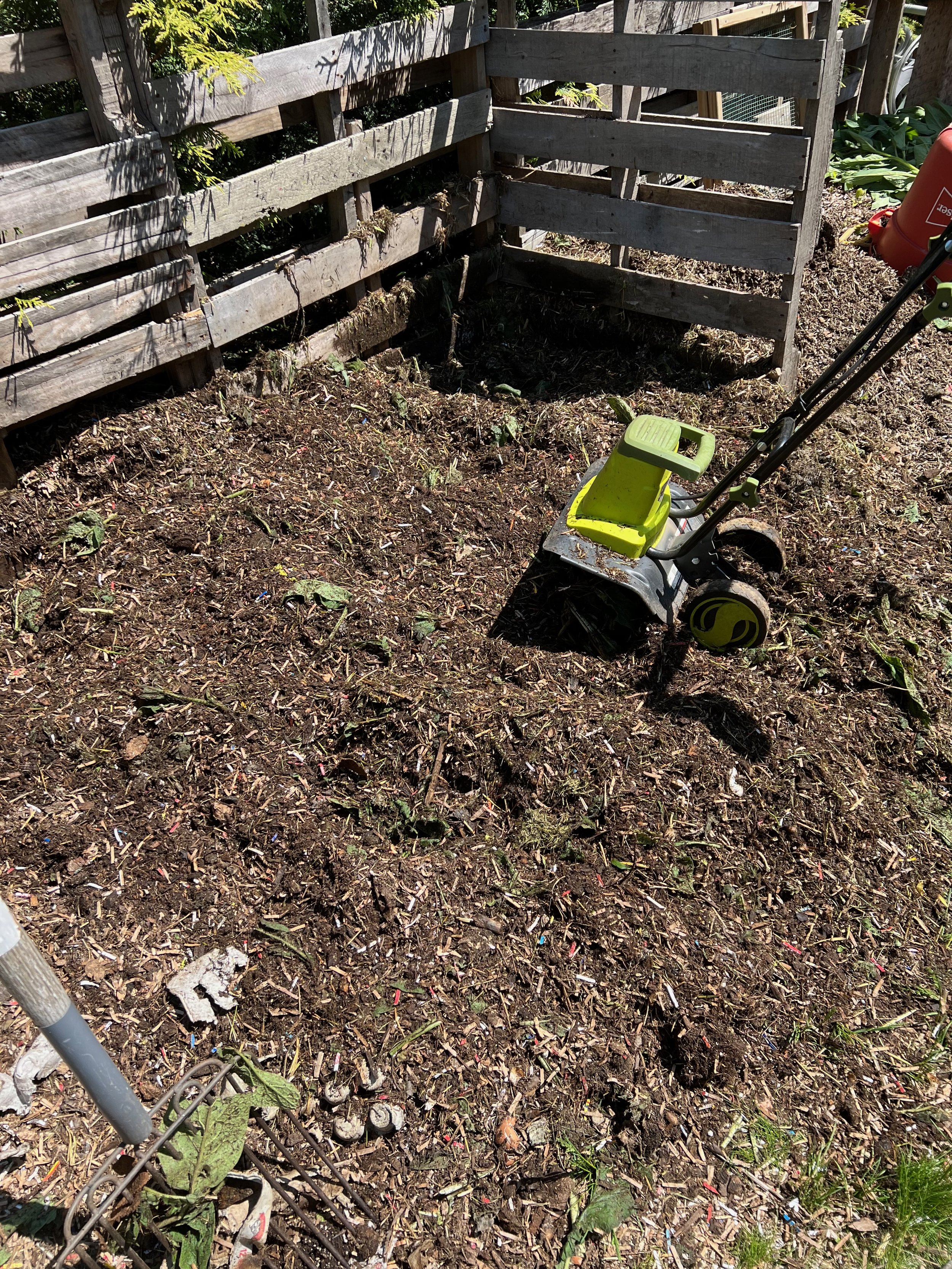
Chopping the raw compost pile with the little electric tiller, in front of the pallet bins, 2022.
How To Prepare the Soil for Planting
Start from your soil test. Add only what it says is lacking. My first test showed low levels of organic matter, so I composted the unamended ground accordingly.
Clear the ground without poison. To turn lawn or weeds into a bed, cover the area with a tarp or black landscape fabric for several weeks to a full winter, until everything beneath is dead. Then rake off the debris (it goes in the compost) and pick out the stones.
Add compost every year. A layer of two to four inches each spring or fall, on every bed, is the habit that builds soil. Composted manure works well, too, and I've found that it doesn't need to be applied as thickly, as one to two inches seems to work just fine.
Loosen, don't flip. Use a broadfork to open up compacted soil 10 to 12 inches deep. If compost won't move below a compacted layer, mix just the top few inches with a small tiller, and no deeper.
Mulch the surface. Shredded leaves on vegetable beds over winter, straw around strawberries and garlic, wood chips around trees, shrubs, and paths. Mulch holds moisture, smothers weeds, and becomes soil as it rots. My favorite mulch is chopped or shredded straw.
Grow a cover crop when a bed is empty. In Maine, sow oats and field peas in late summer or early fall. They winter-kill, and in spring you can plant through the dead stalks. Clover and buckwheat suit summer gaps. The principle is to leave no planting bed bare for any length of time.
Rotate what you grow. Don't plant the same crop in the same place year after year. At Old Souls, corn grows for two years in the South Orchard's upper berms, then moves to the North Orchard's for two, while potatoes take the ground the corn has left.
Wait for warm soil. Cold, wet soil rots seeds and stunts transplants. An old gardener's rule says plant potatoes when the dandelions bloom; I check with a meat thermometer and wait until the soil reaches about 50°F, or higher depending on the crop. For example, I don't like to plant green peppers or tomatoes before the ground is consistently 60°F or higher.
On a smaller lot: a small bin, fed with kitchen scraps and your own fall leaves, will make enough compost for a few beds. A yearly layer of compost, a winter blanket of leaves, and a fall cover crop will improve almost any bed.
To Dig Deeper
UMaine Cooperative Extension, Bulletin #1143, Home Composting. The basics for Maine gardeners.
Maine DACF, Jumping Worms: Fact Sheet for Composters. Identifying them, heat-treating compost, and keeping them out.
Eliot Coleman, The New Organic Grower (Chelsea Green, 3rd ed., 2018). The classic on building fertile soil for vegetables, from the Maine grower whose methods shaped mine.
Eliot Coleman, The Self-Fed Farm and Garden: A Return to the Roots of the Organic Method (Chelsea Green, 2025). The chapter on "intelligent tillage" (pages 67–80) is the case for shallow tillage.
Jessica Walliser, Plant Partners: Science-Based Companion Planting Strategies for the Vegetable Garden (Storey, 2020). Clear on cover crops, including the oats that changed my plan.
This guide is adapted from a book in progress about the residential farm-garden. To hear when it's ready, sign up for news.
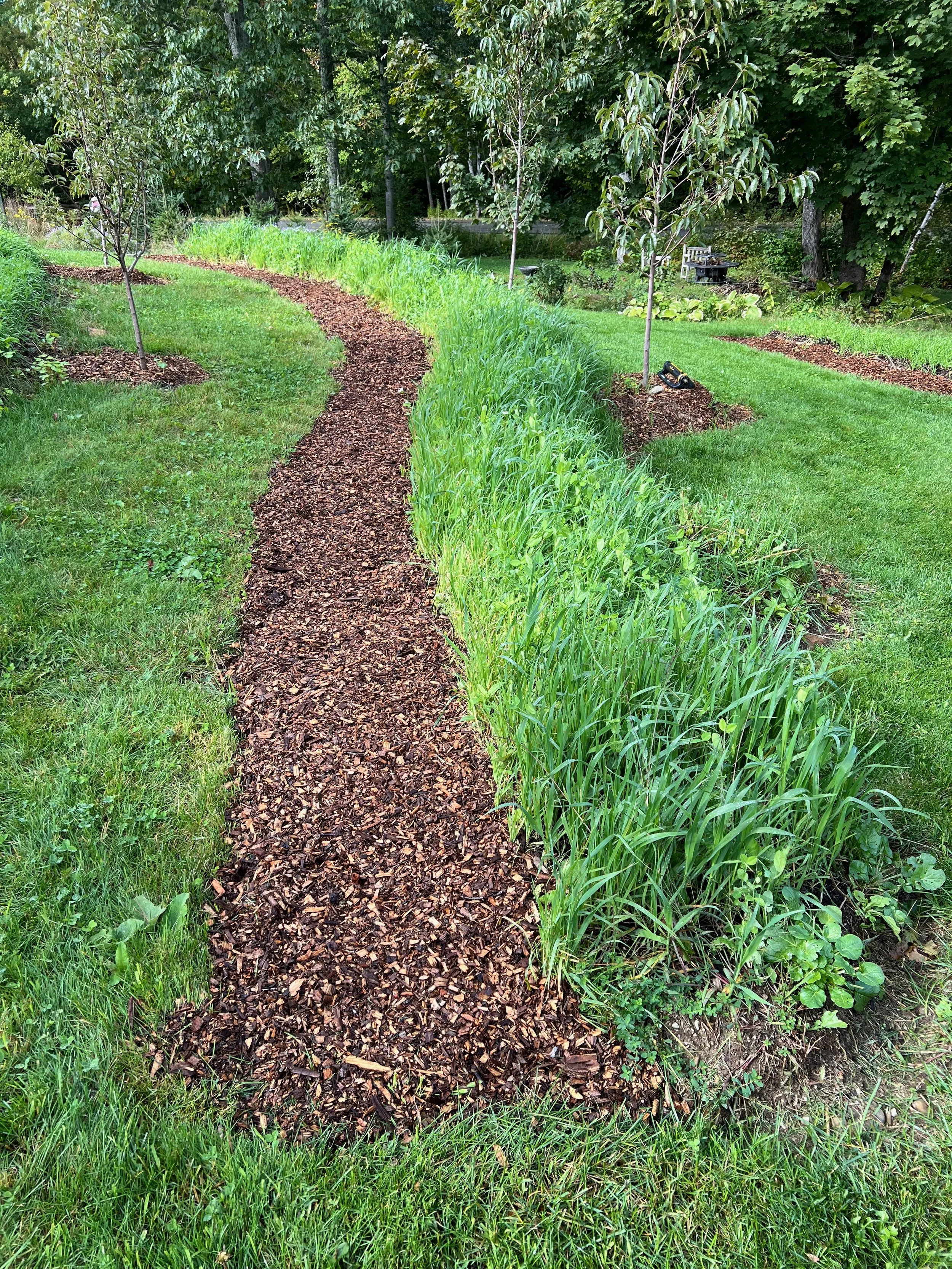
A wood-chip swale between cover-cropped berms, 2022.