How To Observe Your Land
A guide from Old Souls microFarm for residential farm-gardeners
You're eager to start planting, or amending the soil, or clearing lawn. But it's vitally important to take stock of what you have to work with, to observe carefully and to do so over the passage of time. I have to admit I wasn't very good at this to begin with. As a physician I had been trained to closely observe the human body, but not to pay much attention to the natural world.
Observation is among the first principles of permaculture, and it's key to everything else, including planning and design. The eye can see many things, but to observe takes time and patience and concentration. I'm not a particularly patient person, so I have had to practice standing or sitting quietly in some place on my property in order to take in more fully what is there.
Observing doesn't require hours of quiet sitting, either. It can happen during activity. While clearing a stand of willows and pines along the southwestern border, I noticed how muddy the ground stayed for days after the rain. Twice I got my boots stuck in the muck. I came later on to appreciate that there was a subsurface layer of clay here, and that this corner of the property would be an excellent place for a small pond.
A full year of watching is ideal, since each season shows you something the others hide. But even one careful season will save you mistakes. Here is how to begin.
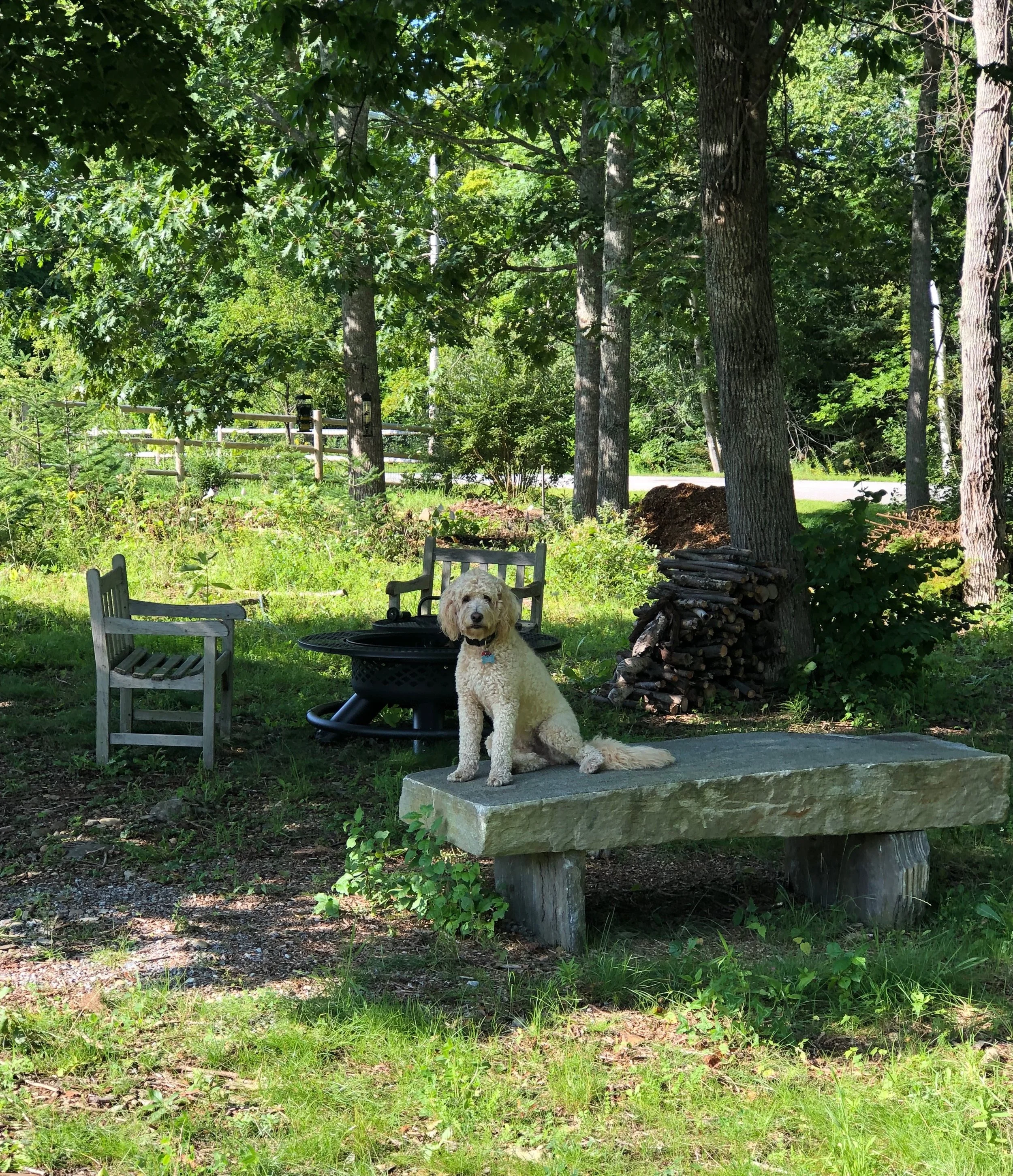
Coby on the granite bench in the Sanctuary Forest, my observation post, 2021.
Six Steps
Pick an observation post or two. A bench, a step, a stump: somewhere you'll actually sit for ten or fifteen minutes. Mine is the granite bench in the Sanctuary Forest.
Watch the light. Note which way your house faces; it sets the broad pattern. Then check your favorite spots at morning, noon, and late afternoon. Note which get six or more hours of direct sun, which get part sun, and which stay shaded. Check the same spots again through the seasons, since the sun's angle changes more than you'd expect.
Walk in the rain, and again in a drought. Do it more than once before you plant anything permanent. Where does water run, pool, or vanish? What comes onto your land from the street, a neighbor's yard, or your own roof?
List what grows, before you clear anything. Keep the mature trees, especially native ones like oaks, unless you have a strong reason not to. A tree that took twenty years to grow can't be replaced by one you plant this spring. Note which plants thrive and which struggle, and where. Bare spots, crabgrass, moss, and brambles are all telling you about soil, light, and water.
Notice who visits. Which birds come, and where do they perch or feed? Where do the deer cross? Animals show you edges, cover, and paths.
Write it down and mark it on a map. Observations you don't record fade by the next season. Record how you feel about an area or the plantings there or sunset viewed from that spot. What makes you smile or frown, or seems confusing?
On a smaller lot: the job is the same, although it might take less time. Pay special attention to shade from buildings and neighbors' trees, shade that matters more on a small lot than a large one.
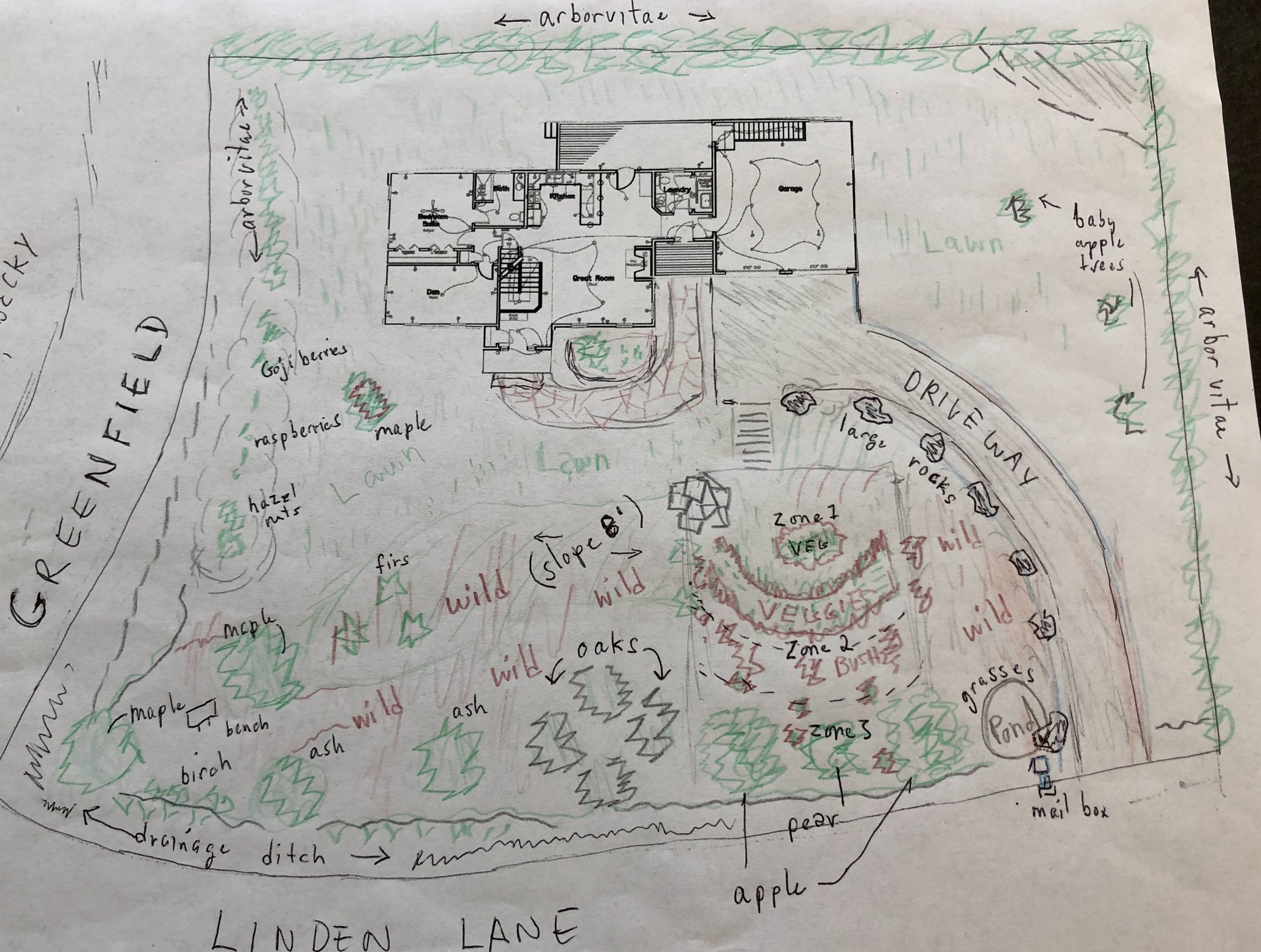
The first plan for Old Souls, sketched over the house plan, July 2020.
A caution from experience. Even accurate observation doesn't guarantee success. It has to be matched with knowledge. I once planted a rhododendron based on a sunlight observation that turned out to be incomplete; the spot got several hours of hot summer sun the plant simply couldn't handle well. It survived, but it would have been much happier among the birches, in partial shade most of the day.
To Dig Deeper
Toby Hemenway, Gaia's Garden: A Guide to Home-Scale Permaculture (Chelsea Green, 2nd ed., 2009). The book that shaped my zone layout, written for ordinary yards.
Dave Jacke with Eric Toensmeier, Edible Forest Gardens, Volume 2 (Chelsea Green, 2005). Detailed, practical guidance on site analysis.
Douglas W. Tallamy, The Nature of Oaks (Timber Press, 2021). Why the big trees you already have matter.
This guide is adapted from a book in progress about the residential farm-garden. To hear when it's ready, sign up for news.

Who visits tells you what your land offers: a great blue heron watching the pond on a foggy morning, 2024.