How To Make a Native Meadow
A guide from Old Souls microFarm for residential farm-gardeners
On the morning of June 13, 2021, I woke up in what I called in my journal "full anxiety mode." In three days Andrew Di Fiori and I were going to plant a meadow in my front yard. My friend Ben Kimball and I had already spent at least ten hours tilling, raking, and prying rocks out of the ground to get it ready. I was terribly worried about the dogs, mine and the neighbor's, racing through hundreds of newly planted, and expensive, grass plugs. Before breakfast I ordered 200 feet of four-foot plastic fencing. It came in time.
Thirteen months later, on July 26, 2022, I walked down to that same strip of ground and wrote: "I've never seen this many Monarch butterflies in one spot." The butterfly milkweed was blooming orange, the swamp milkweed pink, the liatris white, and the bees were working on all three.
The Faux Meadow was my experiment in planting natives as a full meadow replacing grassy lawn: just over 800 square feet of front lawn turned into a meadow of native flowering perennials set in a matrix of native grasses. I call it the Faux Meadow because it's man-made: a designed planting, not a meadow that grew up on its own. The design came from Andrew Di Fiori of Maine Garden Design. It follows an approach that Thomas Rainer and Claudia West describe in Planting in a Post-Wild World: plant in layers the way wild plant communities grow, with a low, dense base of grasses covering the ground and taller, showier flowers rising out of it. Here is how to make one.
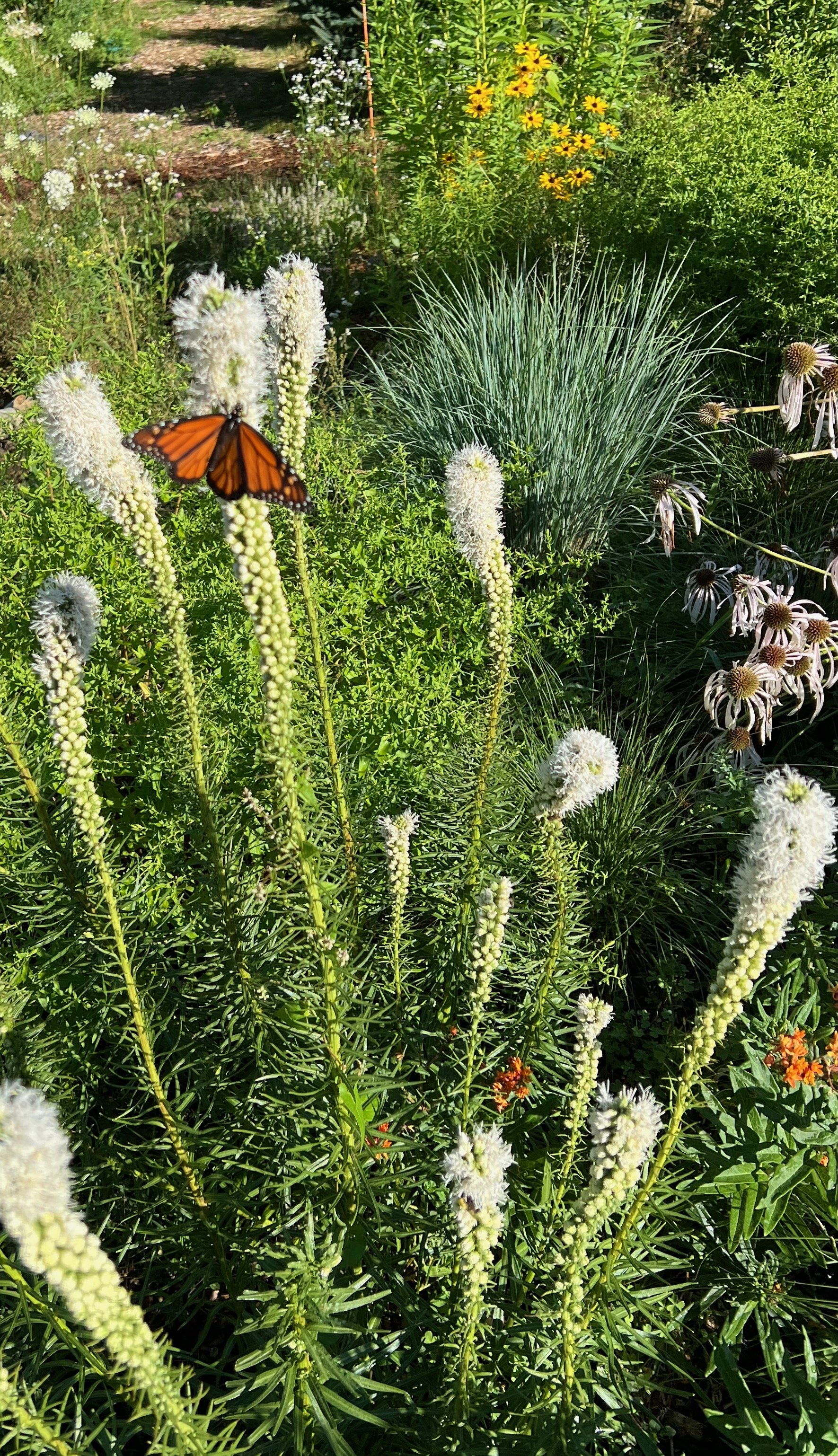
July 26, 2022: a monarch on the white liatris, the day I wrote, "I've never seen this many Monarch butterflies in one spot."
How To Make a Native Flowering Perennial Meadow
Pick a sunny spot, and start small. Most meadow plants want at least six hours of sun. A strip of a few hundred square feet is plenty for a first meadow, and you can always add to it.
Kill the lawn without poison. Cover it with black plastic or a heavy tarp, weighted at the edges, for a full season; fall to spring works well. Or smother it under layers of cardboard topped with several inches of mulch or compost. Either way, no light means no grass.
Prepare the ground. Rake off the dead turf and compost it. Loosen the soil, pull out the stones, and work in a modest amendment if your soil test calls for it. Most meadow natives don't want rich soil; too much fertility favors weeds. If you'd rather not till, plant plugs straight through the dead, smothered sod.
Design in layers. Choose one to three native grasses as the matrix, a large share of the planting, and set five to ten flowering perennials into it, chosen so something blooms from early summer to frost. Little bluestem, prairie dropseed, and, in Maine, native sedges make good matrix plants.
Plant plugs, close together. Plugs cost more than seed, but they establish fast and let you place every plant. Set them about a foot apart, close enough that the plants will cover the ground within two seasons, and water them in.
Or sow seed, and be patient. Seeding costs far less but takes longer. Sow on prepared ground in late fall or winter, so the cold can do its work. A seeded meadow is usually described as sleeping its first year, creeping its second, and leaping its third.
Protect and water the first season. Water deeply during dry spells the first summer. Fence out dogs, and deer if they're a problem, until the plants are established.
Weed hard for two years. Until the grasses close ranks, pull weeds and lawn grass that creep back, before they set seed. After that, the meadow does most of its own weeding.
Leave it standing for winter, and cut it back in spring, after the overwintering insects have emerged.
Frame it. Mow a clean edge or a path, or set a low stone border, so neighbors can see the wildness is on purpose.
Preparation is everything. At Old Souls I covered the lawn with black plastic tarp in the fall of 2020, and it stayed down nine months. When Ben Kimball and I pulled it off on June 5, 2021, everything underneath was dead and dry. Then I went over the ground with my small electric tiller, again and again. Every pass brought up more rocks, hundreds in all, some as big as a softball. I kept at it for a week, an hour or more a day, until the ground was a loose loam about six inches deep. Some of the stones didn't go far: they now edge the meadow, so the ground's own rocks became its border. It's the least visible step in making a meadow, and probably the one that mattered most.
What we planted. Andrew chose two grasses and seven flowering perennials, so that something is in bloom from early summer through fall:
Grasses: prairie dropseed (Sporobolus heterolepis) and little bluestem 'Prairie Blues' (Schizachyrium scoparium).
Early summer: foxglove beardtongue (Penstemon digitalis) and false indigo (Baptisia australis).
Summer: butterfly milkweed (Asclepias tuberosa), pale purple coneflower 'Hula Dancer' (Echinacea), and gayfeather 'Floristan White' (Liatris spicata).
Fall: aromatic aster 'October Skies' (Symphyotrichum oblongifolium) and goldenrod 'Fireworks' (Solidago rugosa).
By July 2023, two years after planting, the meadow had filled in. Starting from plugs is a large part of why it took hold so quickly.
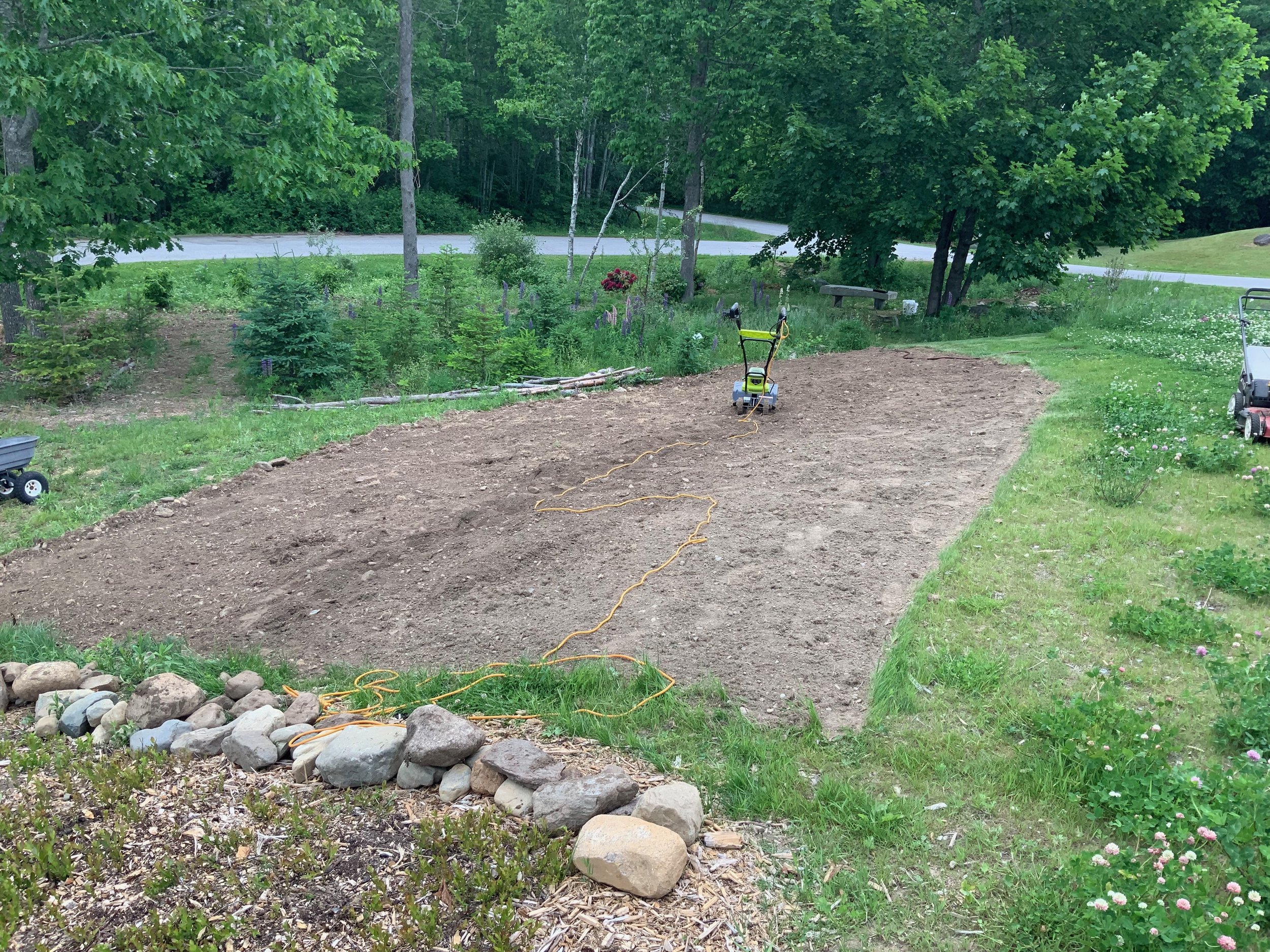
June 5, 2021: tilled, raked, and stone-picked, with the stones already edging the bed. "Preparation is everything!"
Tending to Wild
I admit to being under the illusion when I started the Faux Meadow that it would be a largely no-maintenance project. But within a couple of summers I learned that some plants thrive so well they start crowding out their neighbors, and others arrive as volunteers, while still others might decide to dwindle or disappear entirely. The work is in keeping the balance. I think about the passage in Milton's Paradise Lost each time I study my meadow. Eve tells Adam:
what we by day Lop overgrown, or prune, or prop, or bind, One night or two with wanton growth derides, Tending to wild.
That is a meadow exactly.
Goldenrod and milkweed. Holding back the goldenrod has become the main task, and the milkweed needs the same attention. Both are valuable natives, and both will take over if I let them. I pull some plants where they're crowding others, cut out stems that are shading their neighbors, and dig up and divide clumps that have grown too large. I give extra plants, baptisia especially, to other gardeners, which spreads natives beyond Old Souls at no cost.
Spring, not fall. The meadow gets almost no fall cleanup. Its standing seed heads feed the goldfinches and juncos through the winter, and its hollow stems and leaf litter shelter the insects that overwinter there. Waiting until spring gives them the chance to emerge before I cut anything.
The mown edge. I keep the strip where the meadow meets the lawn mowed on purpose. A crisp mown edge beside a meadow tells the neighbors and passersby that the wildness is intended, not neglected, and in a residential neighborhood that matters a great deal.
On a smaller lot or space: a meadow doesn't need a slope or a field. It can grow in a sunny strip along a drive or the street, or a ten-by-ten patch of front lawn, planted with one grass and three or four flowers, and will bring in bees and butterflies the first summer.
To Dig Deeper
Thomas Rainer and Claudia West, Planting in a Post-Wild World: Designing Plant Communities for Resilient Landscapes (Timber Press, 2015). The thinking behind layered, grass-matrix plantings.
Douglas W. Tallamy, Nature's Best Hope: A New Approach to Conservation That Starts in Your Yard (Timber Press, 2020). Why native plants matter so much to insects and birds, and how to turn lawn into habitat.
Wild Seed Project, wildseedproject.net. Native seed for Maine meadows and guides to sowing it.
This guide is adapted from a book in progress about the residential farm-garden. To hear when it's ready, sign up for news.
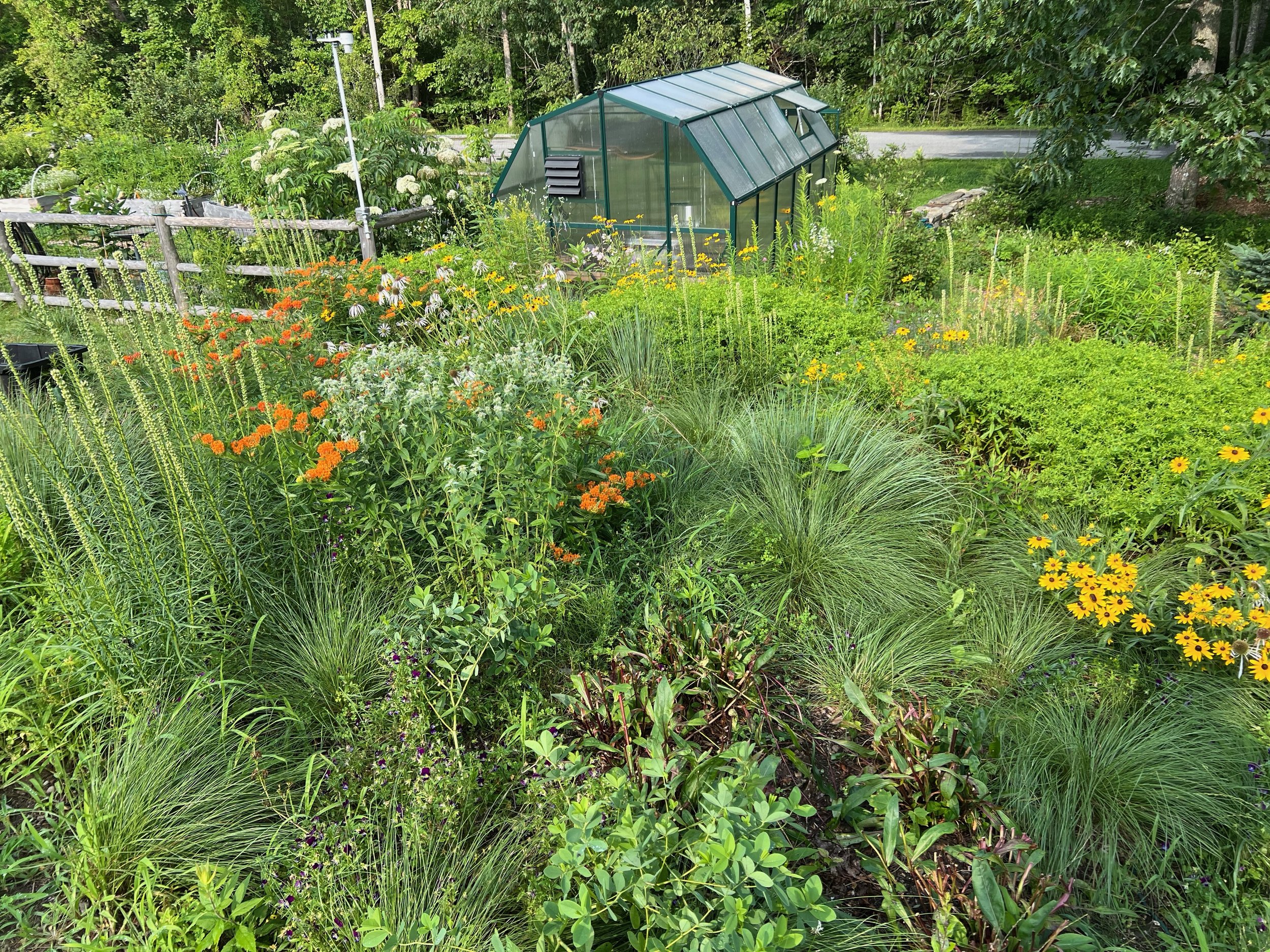
The Faux Meadow at peak, July 2023, two years after planting, with the greenhouse beyond.